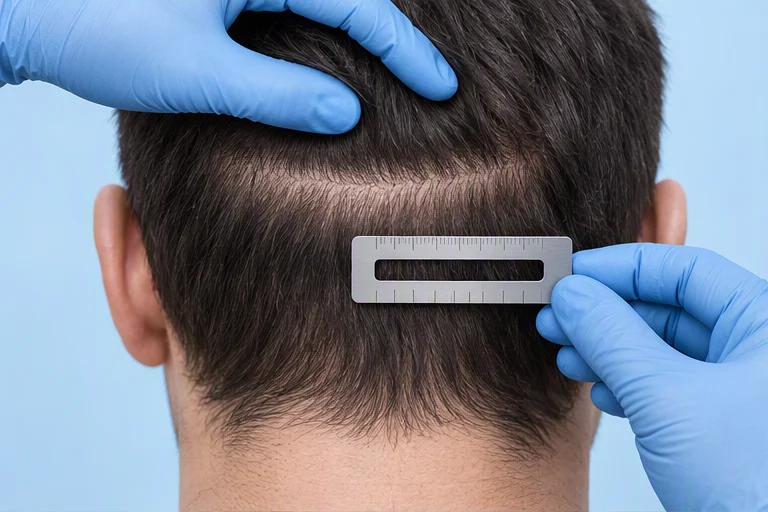
STEP 1
Donor planning
The surgeon measures donor density and scalp laxity to determine how wide a strip can be taken and closed without tension.

Strip – also called FUT – removes a thin band of scalp from the donor area and dissects individual grafts from it. The procedure is planned by the length and width of the donor strip, not by a promised graft number. The final graft count is recorded after dissection. It leaves a fine linear scar that hair of about a centimetre covers.
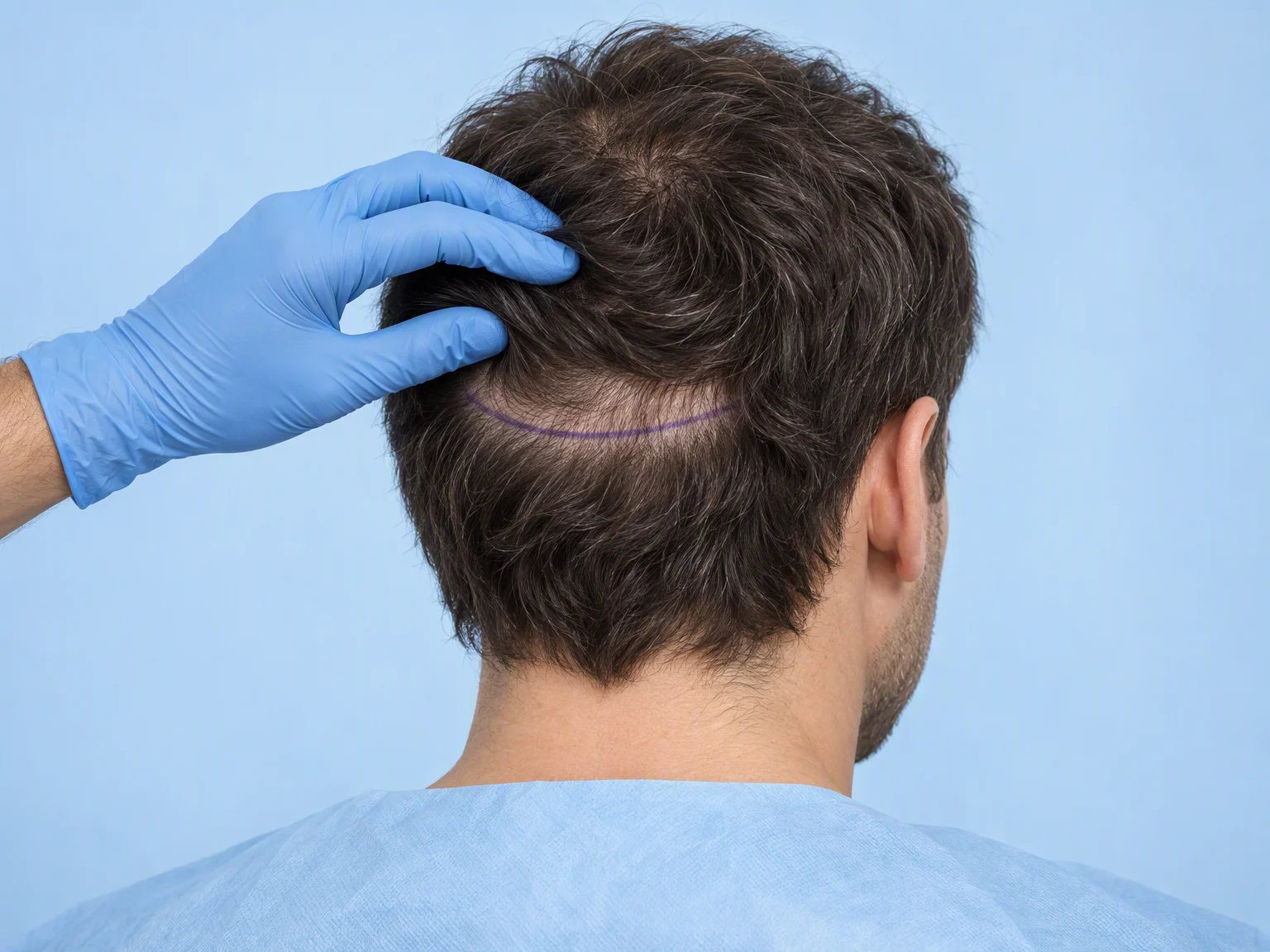
This clinic is FUE-primary. Strip earns its place in a minority of cases – usually advanced loss where the entire scalp needs coverage and the donor area has the density to supply it. When that is your situation, Strip does something FUE cannot, and we would rather tell you so than perform two smaller procedures for the same money.
Strip at a glance
The surgeon measures donor density and scalp laxity to determine how wide a strip can be taken and closed without tension.
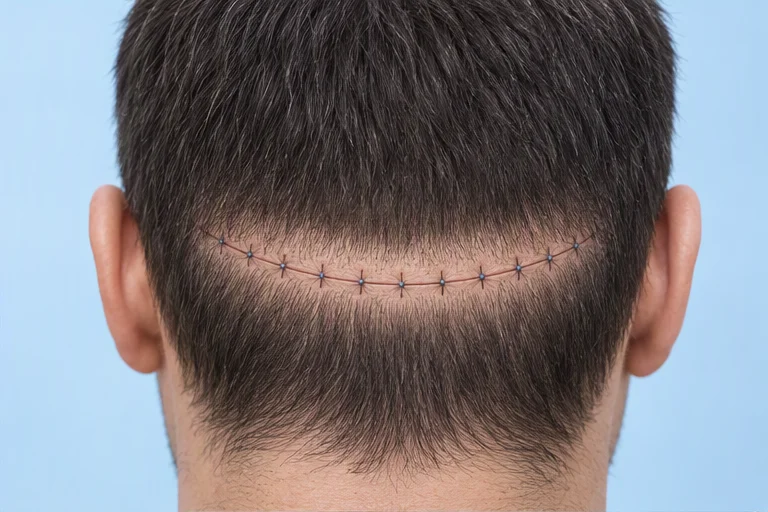
A thin band is removed under local anaesthesia and the edges are closed with fine sutures, placed to keep the resulting line as narrow as possible.
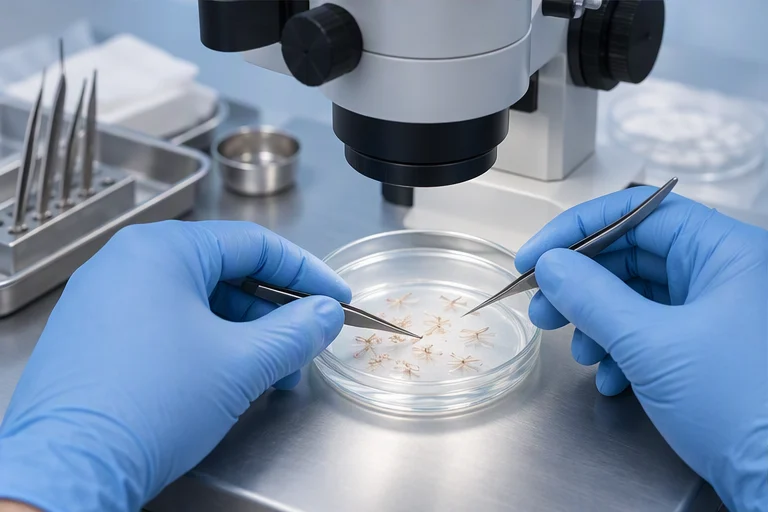
The strip is divided into individual follicular units under magnification and sorted by hair count – the stage that determines how many usable grafts the harvest yields.
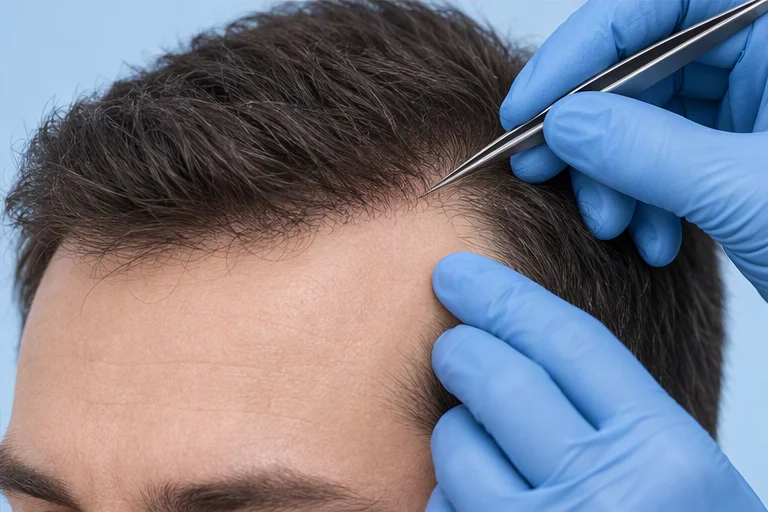
Grafts are placed at the natural angle, direction and density of your existing hair, exactly as in an FUE procedure.
For most patients the answer is no, and we will say so. Where it is yes, it is usually clear-cut.
FUE removes follicular units one at a time through tiny circular punches, leaving dot-sized marks. Strip removes a thin band of scalp from the donor area, from which grafts are then dissected under magnification, and closes the gap with sutures. Strip yields more grafts in a single sitting; FUE leaves no linear scar. Both transplant the same follicles into the same recipient sites.
It is a fine line, hidden by hair of roughly 1 cm or longer. It becomes visible if you shave the back of your head. Closure technique affects how fine it stays, but no technique makes a linear scar disappear – anyone who tells you otherwise is overselling.
Because it serves most cases as well or better without a linear scar, and it leaves more options open for future procedures. We use Strip when the case calls for it – chiefly when a patient needs a very large number of grafts in one session – not as the default.
Yes. In cases of extensive loss, combining a strip harvest with FUE extraction from a wider donor zone produces the highest total graft yield available in a single day. Your surgeon will tell you if your case is one of them.
Often, yes. FUE grafts can be placed directly into the scar tissue to camouflage the line, and in some cases the scar can be surgically revised. This is part of our corrective work.