Hairline lowering
Bringing a naturally high forehead down and rounding the hairline. The most predictable procedure we perform on women, because the donor area is typically untouched by any thinning process.

The shaving plan for a woman's hair transplant is chosen according to the case, and the hairline design is different from a man's. Non-shave FUE may be offered when it is the more suitable option. In other cases the recipient area can remain unshaved while a concealed zone of the donor area is trimmed for extraction. Surgery works best for localised loss where the donor area is stable.
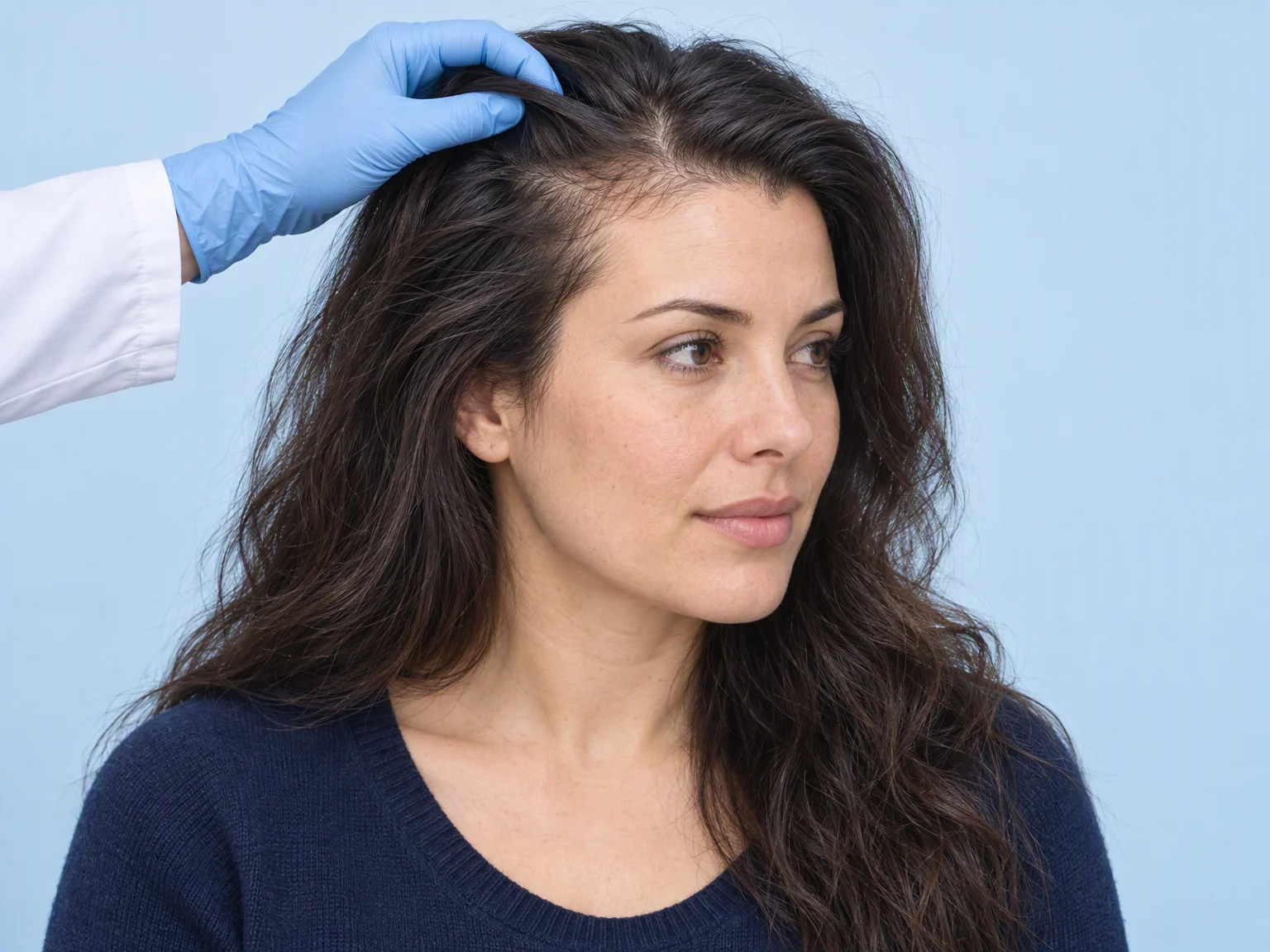
Two things require individual planning in a female procedure. First, the surgeon decides whether non-shave extraction, a concealed donor-zone shave or a different approach is most appropriate. Second, the hairline being rebuilt has a different shape – lower, rounder and irregular by nature. Applying a male template to a woman's head is the most common reason a female transplant looks like one.
Bringing a naturally high forehead down and rounding the hairline. The most predictable procedure we perform on women, because the donor area is typically untouched by any thinning process.
Loss along the hairline and temples after years of tight styling. Grafting works well once the tension has stopped – and only once it has, or the new hair follows the old.
Adding density where loss is confined and the donor zone is demonstrably stable. Assessed carefully, because diffuse involvement is the common disqualifier.
Facelift incision scars, and scars from earlier surgery along the hairline. Covered in more detail on our transplant-into-scars page.
Whether you are a candidate is decided by your donor area, not by the list above. That question – and the causes behind female hair loss – is covered on hair loss in women, and settled properly at diagnosis.
A man's hairline recedes at the temples and sits high, and rebuilding it means restoring a recognisable shape. A woman's sits low, curves continuously with no temporal recession, and its border is not a line at all – it is broken up by fine, single, unevenly spaced hairs that soften the transition into the forehead.
Reproducing that takes single-hair grafts placed in a deliberately uneven front row, with the irregularity designed, not left to chance. A neat, symmetrical, evenly spaced hairline is what a transplant looks like when it was planned to a male template – and once it has grown in, it is a difficult thing to undo.
Not always. Non-shave FUE may be offered when it is the better option for your case, but it is not necessary or suitable for every patient. In some procedures the recipient area is left unshaved while a narrow zone in the donor area is shaved for extraction. The surrounding longer hair can cover this donor zone, making it less visible during recovery.
Fewer women than men, and the reason is the donor area. Male pattern loss spares the back and sides, which gives a reliable place to harvest from. Female pattern loss is often diffuse and can involve the donor zone itself, and taking hair from thinning donor hair produces a poor result while permanently costing you density there. Where loss is localised and the donor is stable, results are excellent.
A woman's hairline is lower, rounder and much less regular than a man's. It has no receding temporal points, and its border is broken up by fine, irregular "whisker" hairs rather than running as a clean line. Rebuilding it means placing single-hair grafts in a deliberately uneven front row – a symmetrical, evenly spaced hairline is the signature of a transplant done to a male template.
In many cases yes, and sometimes instead of surgery. If the cause is a shedding process, a hormonal change or a deficiency, treating it can recover hair no transplant could give you, and operating on an unstable scalp wastes grafts. The assessment establishes whether that is your situation, and refers to treatment where surgery would not hold.
Usually not. Diffuse thinning means there is no unaffected area to move hair from – a transplant redistributes hair, it does not create it. Where the whole scalp is involved, medical treatment is the appropriate route.
Gentle washing starts the day after, normal brushing within a week or so once crusting has cleared, and colouring after about four weeks. The amount of shaving depends on the surgical plan. When the recipient area remains unshaved and only a donor zone is trimmed, the surrounding hair can help conceal the treated areas during early recovery.