Advanced FUE
Our primary technique. Follicles are extracted individually with a sub-millimetre punch. No linear scar; up to 6,000 grafts when clinically required and supported by the donor area.
Read more →
We perform FUE-based hair transplantation as our primary technique, with Non-Shave FUE, Long Hair transplantation and Strip available where the case calls for them. Hairline is led by Prof. Irakli Bebiashvili and staffed by five named surgeons. Grafts are counted during extraction, protected during handling and documented in the patient record.
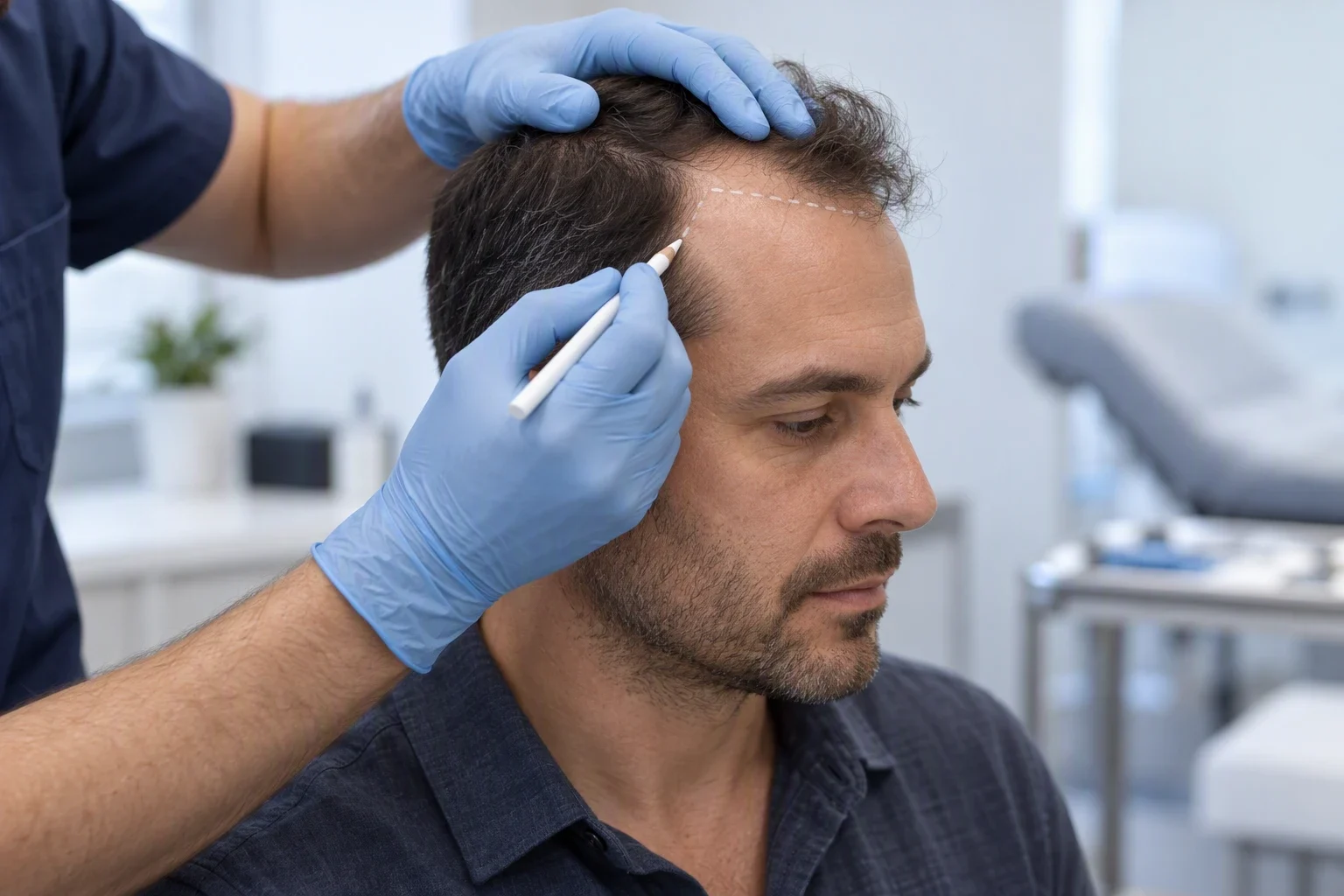
Our primary technique. Follicles are extracted individually with a sub-millimetre punch. No linear scar; up to 6,000 grafts when clinically required and supported by the donor area.
Read more →Existing hair stays uncut in both donor and recipient areas. Suits selected density-enhancement and repeat procedures where hair can cover healing sites.
Read more →Grafts transplanted with the hair still attached, so you leave with the final look in place rather than waiting for growth.
Read more →Used when donor anatomy and the surgical plan favour a strip harvest. Yield is assessed individually; it leaves a linear donor scar.
Read more →Filling patchy growth, thickening a sparse moustache and camouflaging scars within the beard, with grafts from your own scalp.
Read more →Single-hair grafts rebuilding over-plucked, scarred or naturally sparse brows at the flat angle brow hair grows at.
Read more →Planned case by case, with non-shave or concealed donor-zone shaving where appropriate, and a lower, rounder hairline design – not a male template.
Read more →Grafting into strip scars, burns, surgical scars and traction alopecia. Lower density and lower survival than untouched scalp.
Read more →Suitable beard or body follicles used as additional scalp donor grafts, including selected repair cases with depleted scalp reserves.
Read more →Correcting transplants performed elsewhere – unnatural hairlines, pluggy grafts, donor scarring and missing density. Each case is planned around the healthy donor hair that remains.
Read more →Three things decide it, and none of them can be settled from a website.
Density at the back and sides sets the ceiling on everything else. It is the first thing the surgeon measures.
A receding hairline and a bald crown are different operations with different graft counts and different methods.
If you cannot take visible downtime, Non-Shave or Long Hair transplantation solves that – at the cost of session size.
For most patients, Advanced FUE – it leaves no linear scar and suits the majority of hair loss patterns. Hairline can transplant up to 6,000 FUE grafts in one session when clinically required and supported by the donor area. Non-Shave FUE and Long Hair transplantation suit more discreet procedures. Strip is planned from the donor-strip dimensions when the case calls for it. Your donor area usually decides.
It depends on the area being covered and the density you start from. A receding hairline typically needs 1,500–2,500 grafts; a hairline plus mid-scalp 2,500–3,500; extensive loss including the crown 4,000 or more. Hairline can transplant up to 6,000 FUE grafts in one session when clinically required and supported by the donor area. Requirements around 8,000–10,000 grafts or more are staged, typically beginning with about 4,500 grafts. Your exact plan comes from the assessment.
Yes. Follicles are taken from the donor zone at the back and sides of the head, which is genetically resistant to the hormone that causes pattern hair loss. They keep that resistance after transplantation and continue growing for life.
The procedure is performed under local anaesthetic – you feel the numbing injections and very little after that. Most patients read, watch films or sleep through it, and go home the same day.
Transplanted hairs shed between weeks two and four, which is normal and expected. Regrowth begins around month three, visible density arrives by month six, and the final result is assessed at twelve months.