Patchy growth
Areas that have never filled in, most often the cheeks and the corners of the jaw. Grafts are placed to blend into existing growth rather than as an obvious island of new hair.

A beard transplant moves follicular units from the back and sides of your scalp into the beard area, where they grow permanently. It fills patchy growth, thickens a sparse moustache and camouflages scars within the beard. A full beard runs to 2,000–3,000 grafts, a moustache alone 400–800, and the result is assessed at twelve months.
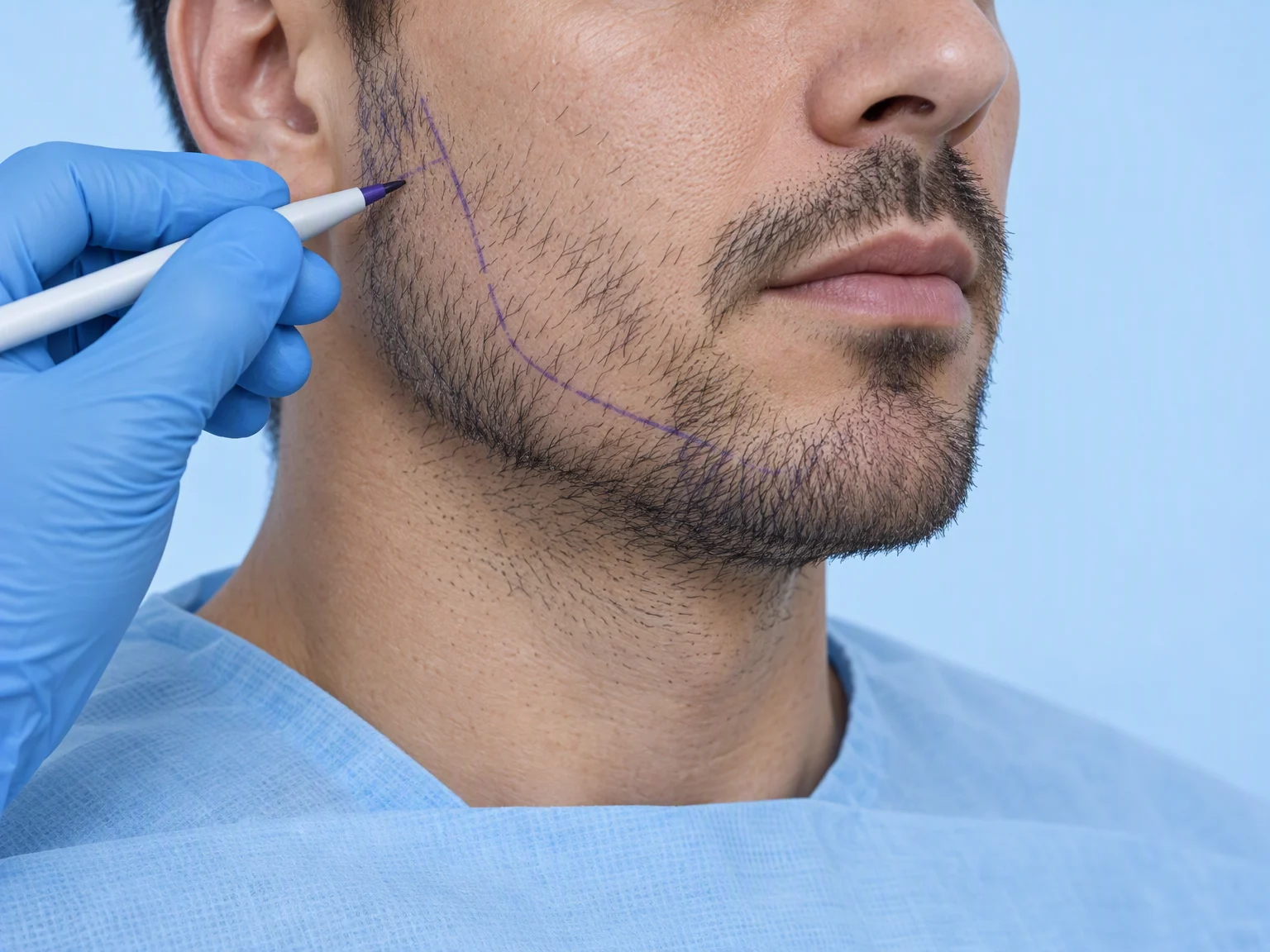
Facial work is less forgiving than the scalp. Beard hairs emerge at a much sharper angle, the borders have to be built from single-hair grafts, and a design that is a few millimetres wrong reads as wrong from across a room. The technique is the same as FUE; the judgement is not.
Areas that have never filled in, most often the cheeks and the corners of the jaw. Grafts are placed to blend into existing growth rather than as an obvious island of new hair.
The upper lip needs the finest work on the face – single-hair grafts, placed at a very acute angle so the hair lies down rather than standing out.
Acne scarring, surgical scars and cleft-repair scars can be camouflaged with grafts placed into and around the scar tissue. Survival in scar tissue is lower, so these are planned conservatively.
Sharpening a jawline, lowering a cheek line, or adding weight to a beard that grows but reads as sparse.
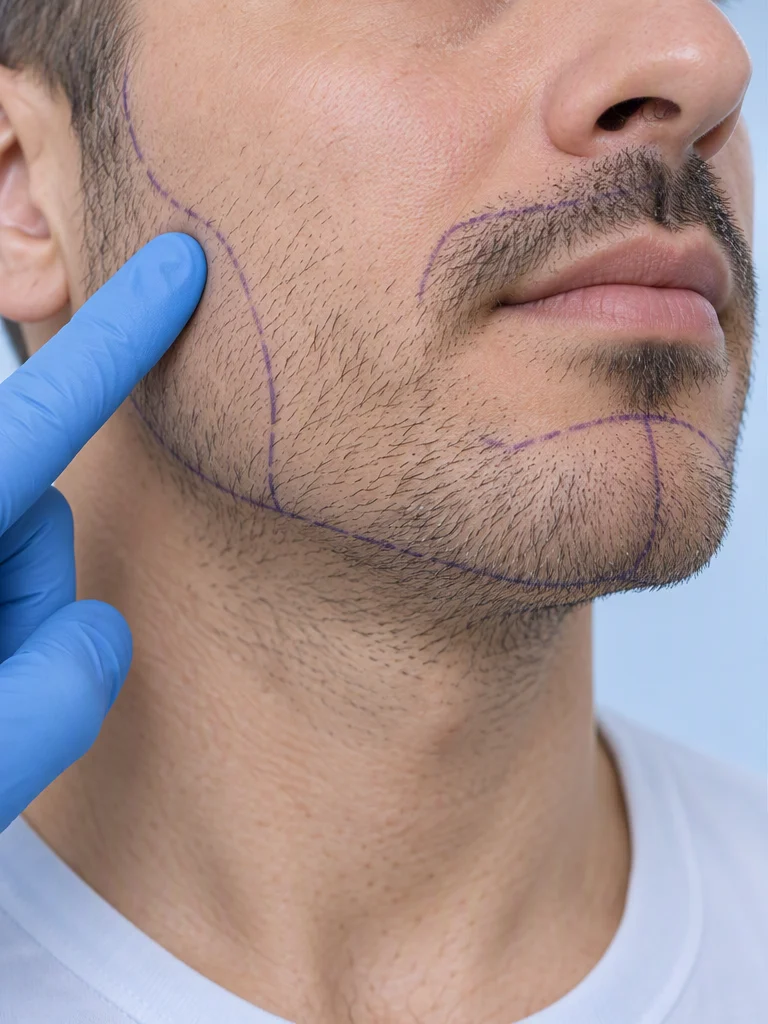
Scalp hair leaves the skin at roughly 45 degrees. Beard hair lies almost flat against the face, and a graft placed at a scalp angle stands away from the skin and stays that way permanently. Every site on the face has to be made at the angle and direction that region of beard actually grows in.
The second constraint is graft selection. Borders – the cheek line, the moustache edge, the outline of a goatee – take single-hair grafts only. Multi-hair grafts go into the interior where density matters and the individual hairs are not read separately. Getting that the wrong way round produces a beard that looks tufted at exactly the edges people look at.
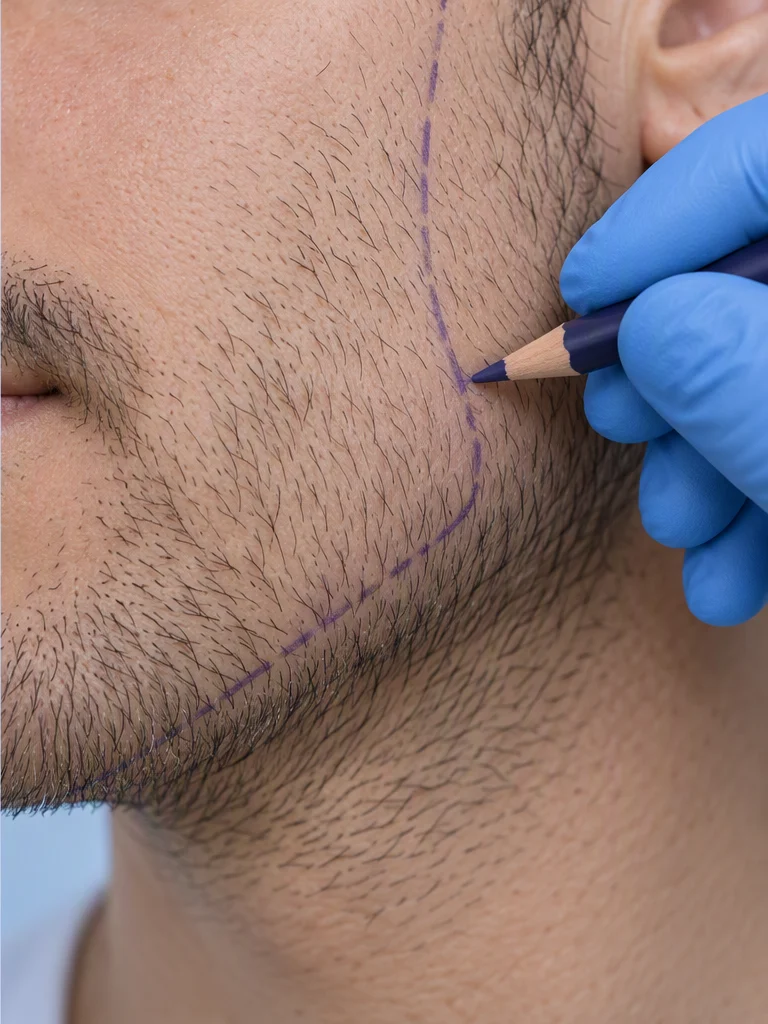
The back and sides of your scalp, the same donor zone used for a scalp transplant. Those follicles are genetically resistant to pattern loss and keep that resistance on the face. It also means the transplanted hair keeps some scalp characteristics – see the question below on texture.
Close, but not identical. Scalp hair is usually finer and straighter than native beard hair, and it grows continuously rather than to a set length, so it needs trimming. Most of the difference disappears once the beard is grown out and blended, but you should know it exists before deciding – a clinic promising a perfect match is overselling.
Yes. The transplanted hairs shed between weeks two and four, exactly as in a scalp transplant, then regrow from around month three and continue for life. The result is assessed at twelve months.
Trimming with scissors or an electric trimmer is usually fine from around ten days. A close razor shave over the transplanted area should wait until the surgeon confirms healing is complete, typically at three to four weeks. Shaving does not damage the follicles once the skin has healed.
The procedure is performed under local anaesthetic and you feel the numbing injections and little else. The face is more sensitive than the scalp, so mild swelling and tenderness for two to three days afterwards is more common than it is after a scalp procedure.
It can, but it competes for the same donor supply. If you may want scalp work later, the surgeon will tell you what a beard procedure costs you in future scalp grafts before you commit, rather than after.